
The COMPAGNIE GÉNÉRALE TRANSATLANTIQUE, known
as FRENCH LINE in the English speaking world, or TRANSAT or CGT, had its
origins in the victorious end of the Crimean War. Supported by the success and a
wave of national consciousness emperor Napoléon
III.
wanted strengthening the French primacy on the oceans.
by Earl of Cruise


These vessels finally are the genes of
which all further comming passenger ships rely on, even the magnificient
NORMANDIE of 1935.

In 1899 and 1900 the sister vessels LA LORRAINE and LA SAVOIE, each 11,168 GT, and built at CHANTIER & ATELIERS DE ST.NAZAIRE S.A. were commisioned. These two vessels again, the biggest French flagged civil vessel and the fastest, again sailed at the peak of the luxury offers on the North Atlantic. Her rivals have been the German Greyhounds of the LLOYD and HAPAG. Smaller than her rivals she have been nearly as fast.

by Earl of Cruise

Houseflag of COMPAGNIE GÉNÉRALE
TRANSATLANTIQUE S.A. - soure: ebay
"On limited space, we put our country on display", a
crewmember declared once.
And no other line put in more of its national personality into its product than COMPAGNIE GÉNÉRALE TRANSATLANTIQUE. |
The
company´s headquarter was situated in Paris, while the homeport of the vessels
had been Le Havre.
The French
navy was gone face since their humiliating defeat by the British under Lord
Nelson at the Battle of Trafalgar 1805. Foreign lines served the most
prestigious and permanent growing route on the Atlantic and delivered French
Mail into the rising USA. Not enough, during the Crimean
War (1853 till 1856) the French had to charter British navy vessels and
civil ships for their expedition army.

Painting by Alexandre Cabanel of Emporer Napoléon III. - source: Wikipedia (Gemeinfrei)
In 1848 Charles
Louis Napoléon Bonaparte became the president of the French Second Republic. He was the
nephew and heir of Napoléon I. He was the first President of France to be
elected by a direct popular vote. But he was blocked by the Constitution and
Parliament from running for a second term, so he organized a coup d'état in 1851 and then took the throne as Napoleon III. on 2
December 1852, the forty-eighth anniversary of Napoléon I.'s coronation. Napoléon created the Deuxième Empire, which despite his autocratic beginnings was named "l´empire libéral". He remains the
longest-serving French head of state since the French Revolution. Since the French Revolution 1789 revolution and counter
revolution took turns and destabilised France.
Napoléon
stabilized the contry. He initialised
with his politics and economic engagements the modernisation and
industrialisation of France. His popularity amoung the Bourgeoisie and speciall amoung the working class was resulted in his book: "Idées napoléoniesennes et dans L´Extinction du Paupéisme" (1844)
|
After the
war Napoléon III. ordered new armored
navy vessels. As he further subsidized the establishing of a line, offering a
passenger and mail service across the Atlantic. It was the COMPAGNIE GÉNÉRALE TRANSATLANTIQUE S.A. Since the days of
Louis XIV. and Colbert prevailed in the French economy of the spirit of
mercantilism. Throughout
his reign emperor Napoléon III. worked to alleviate the sufferings of the poor,
on occasion breaching the 19th-century economic orthodoxy of freedom and laissez-faire
and using state resources or interfering in the market.
More than any other Transatlantic company the
Cie. Gle. TRANSATLANTIQUE was on the one hand a business oriented company,
but on the other side a symbol of national pride. Further the state of France
was a co-owner.
|
A ship of
the CGT is surrounded by an atmosphere which is so subtle that passengers have
not become aware of until the end of the voyage. He knew he experienced a
wonderful trip and a wonderful time. But he cannot hint on not one single unit
or attention that is responsible for.
To conduct
that new venture Emile and Isaac Péreire had been chosen by his majesty
himself. Both personalities have been characteristic for what TRANSAT would
become.
Emile Péreire,
the angel faced man, with bright eyes, had been the ambitious and cunning, as
Isaac Péreire had been rotund, the typical sophisticated Parisienne and the
idealist. Together they have been horse and cart. Both of Portugese heritage
had been successful train pioneers and bankers. Both knowing the worth of the
Franc (penny) combined with patriotism and an idealistic picture of the sea, sea
life and seafaring.

Emile and Isaac Péreire
In 1855,
the Péreire brothers (Emile and Isaac) create the COMPAGNIE GÉNÉRALE MARITIME in Granville.
The Péreire brothers had been of one of 200
families in France with private banks. Amoung these too have been the Rothschild´s.
These families with their banks formed the `Haute Banque´, a rival to the
Banque de France. This bank was a foundation of Napoléon I. The `Haute
Banque´ group financed the French industrialisation and constructing of
railways. But shipping was more or less left out. And especially the railways
created vast fortunes for the exclusive `Haute Banque´ members.
The Péreire brothers eventually financed the
reconstruction of the Louvre which Napoléon III. initiated after his enthronement.
But on the other hand, these families created with their loans the `French Wonder´. |
For the new
company a number of similar seized (108m) and powered (850hp) vessels have been
ordered imediately - WASHINGTON
(1864); LAFAYETTE (1864);
EUROPE (1865); FRANCE (1865); IMPÉRATRICE EUGÉNIE (1865) - 1870
renamed ATLANTIQUE, and again in 1873
AMÉRIQUE; NAPOLÉON III. (1865), renamed in 1870
renamed VILLE DU HAVRE, rebuild in 1871; NOUVEAU MONDE
(1865); PANAMA (1866) and
SAINT LAURENT
(1866).
As the
notable shipbuilders had been situated in Great Britain the Péreire´s ordered
their first new built vessels at these experienced British yards.
SCOTTS
& Co. Ltd. in Greenock delivered the paddle steamers LAFAYETTE in 1863 and
WASHINGTON in 1864. Both vessels were rebuild and enlarged to 4,600 GT, got screw
propulsion, with lengthened hulls, new engines, and the WASHINGTON as a first
with twins screws from one engine in 1868.


LAFAYETTE 1864, sister to WASHINGTON - source: Wikipedia
The first
vessels commissioned for Cie. Gle. TRANSATLANTIQUE in 1862 have been a set of two
sister ships - the FLORIDE and LOUISIANE of 1,859 GT and TAMPICO and VERA
CRUZ of 1,700 GT. These had been first ordered for the Cie. Gle. MARITIME -
this name we will recover later in the 1980s. The line across the ocean into Mexico was of political reasons. Mexico had vast depts at French banks and stoped repaying them. This lead to the military engagement and installation of the Mexican Empire.


First sailing of TAMPICO, sister to VERA CRUZ from Saint-Nazaire for Veracruz - source: Wikipedia

First sailing of LOUISIANA
from Saint-Nazaire for Veracruz, inauguration of the transatlantic line to
Mexico - source: Wikipedia
But
ordering across the channel was a blow to the national of France, the emperor
and the Péreire brothers. They bought on the estuary of the Loire land and erected
a shipbuilding facility with the consultancy of John Scott - CHANTIER &
ATELIERS DE PENHOËT DE SAINT NAZAIRE. This name would become famous for most
luxurious passenger vessels. It was a merger of CHANTIER & ATELIERS de
ST.NAZAIRE S.A. and the PENHOËT yard.


Launching of IMPÉRATRICE EUGÉNIE for the North Atlantic trade - source: Wikipedia
Ludwig
Bemelmanns once praized:
"Chantier is a wonderful name for a
shipbuilder. He sound like a song, or like the name of a beautiful
songbird"
source: Die großen Passagierschiffe, Bd.: Die Seefahrer, Time Life Bücher
|
Since its establishment in 1865 Cie Gle
TRANSATLANTIQUE grew rapidly to 27 vessels, freighter and passenger liner. And
in 1889 the company had 65 vessels with which they have sailed 2,355,000 sm on 1,632 voyages. The TRANSAT hadn´t generated the revenues of CUNARD or made
the same amount of voyages, but it was astonishingly allways up-to-date. Even by ordering "traditional" paddle wheelers.
In mid 19th century, the paddle wheel was a proven technology, with enhenced efficiency for the paddles itself. The shaft and propeller technology was new and trubled with regular shaft damages, which left the vessel without power and relying on sails.
In mid 19th century, the paddle wheel was a proven technology, with enhenced efficiency for the paddles itself. The shaft and propeller technology was new and trubled with regular shaft damages, which left the vessel without power and relying on sails.
In 1864 the FRANCE, the first to bear
that name, was launched at the new shipbuilder PENHOËT. It was a matter of
patriotism and national pride ... She was followed by EUROPE in the same year. In
1865 the IMPÉRATRICE EUGÉNIE followed. They had been copies of the Greenock
built vessels. In 1865 the NOUVEAU MONDE followed, which was built in
cooperation THOMAS IRONWORKS Ltd., London, which also delivered the NAPOLÉON III. in the same year. Both paddle steamers
meassured 3,376 GT.
In 1865 and ´66 NAPIER & SONS Ltd.,
Glasgow, delivered VILLE DE PARIS and PÉREIRE, 3,150 GT sisters which sailed
for CGT till 1888.
PENHOET had learned, from the
cooperations , the consulting and building in license, and delivered in 1866
the 3,413 GT sisters SAINT LAURENT and PANAMA, which were followed by a third, the
L´ATLANTIQUE of 3,400 GT in 1870.
The paddle wheelers were changed from
the end of the 1860s onwards into screw driven steamers. The vessels would
change dramatically - they got new engines, have been lengthend, and got deck
houses.


Ports of destination of Cie. Gle. TRANSATLANTIQUE, displaying the reconstructed paddle wheelers - source: gallica.bnf.fr - Bibliothéque nationale de France
The attractivness of vessels grew too
with changed quarters for the passengers, as well an increasing of the service
level on board, and improving further the high food quality. These food
standards have been the benchmark for the quality of food for NORDDEUTSCHER
LLOYD and HAPAG.
The French - German war of 1870/71 was the end of the Deuxième Empire and the reign of Napoléon III. With his troops he was captured by the troops of Prussia and its allies. The peace treaty was a devasting blow for France, as it had to pay 5mrd Francs, which was the equivalent of 25% of the French economical worth in 1889. The country had to be rebuild as of the destruction caused by the war. Due to these difficulties the dregging of the port of Le Havre had to wait. But France did recover fast. Only five years later, the Third Republic settled, and thanks to the reforms of Napoléon, the economy of France had its old status.

The French - German war of 1870/71 was the end of the Deuxième Empire and the reign of Napoléon III. With his troops he was captured by the troops of Prussia and its allies. The peace treaty was a devasting blow for France, as it had to pay 5mrd Francs, which was the equivalent of 25% of the French economical worth in 1889. The country had to be rebuild as of the destruction caused by the war. Due to these difficulties the dregging of the port of Le Havre had to wait. But France did recover fast. Only five years later, the Third Republic settled, and thanks to the reforms of Napoléon, the economy of France had its old status.

Eugène Péreire, son of Isaac Péreire - source: Wikipedia
The procedure or rebuilding the fleet was
forced further on by the new president Eugène Péreire, the son of Isaac
Péreire, who directed the TRANSAT from 1877 till 1904. The vessels of FRENCH
LINE were then the first implementing cooling in the freight rooms, as well
electric light. And in 1891 LA TOURAINE made a first Mediterranean cruise after
a record crossing of six days annd 21h. She left Le Havre via the Azores to
Constantinople. She copied with that the successful first commercial modern
cruise of HAPAG´s AUGUSTA VICTORIA.
The improvement of the 1860s paddle
steamers made new buildings not that necessary for the 1870s, and reflected the
market shares of TRANSAT on the North Atlantic. But the technical level and the
luxury level grew each year and with each new vessel on the most pretigeous
route in the international shipping trade.
The homeport of Le Havre as having been
a fishing sigth, was limiting the gross tonnage of the vessels Cie. Gle.
TRANSATLANTIQUE could order. This was similar a situation to that of
NORDDEUTSCHER LLOYD and Bremen and Bremerhaven. After dregging the port and
building new facilities the vessels could be build larger.
In 1881 BARROWS S.B. Co. Ltd. of Barrows
delivered the LA NORMANDIE. She was a vessel of 6,283 GT and the peak of luxury
at sea. Her single real competitors have been the last vessels of the Flüsse
Klasse of the LLOYD. But LA NORMANDIE offered a novelty, of which even LLOYD hadn´t
thought of - water toiletts.


LA NORMANDIE - source, courtesy Von den Kreuzzügen zu den Kreuzfahrten, Basil W. Bathe

LA NORMANDIE and LA NAVARRE, cutaway and main deck plan - own collection
Four different French shipbuilders
delivered in 1885 and 1886 four sister vessel, for which LA NORMANDIE had been
the blue print for.
LA CHAMPAGNE - courtesy, courtesy by © Georg Link
1885 LA CHAMPAGNE, 7,087 GT from
CHANTIERS & ATELIERS de ST.MAZAIRE S.A.
1886 LA GASCOGNE, 7,071 GT, and in the
same year the larger LA BOURGOGNE, 7,395 GT, from SOCIÉTÉ DES FORGES &
CHANTIERS de la MEDITERRANÉE LA SEYNE.
LA
BOURGOGNE was launched on 8 October 1885. She sailed on her maiden voyage
from Le Havre to New York on 19 June 1886. In 1886, LA BOURGOGNE traveled the Le Havre - New
York transit in a little more than 7 days and set a new record for the
fastest Atlantic crossing by a postal steamer. This gave the company first place in the New York postal service,
and ignited a competition for the record in the trans-Atlantic run.
On
29 February 1896 she ran down and sank the anchored British steamer Ailsa, of the Atlas Steamship Company,
at the entrance to New York harbour.
In 1897/8 she was fitted with quadruple expansion engines and her masts
reduced to two.
LA
BOURGOGNE sank in 1898, with the loss of 549 lives. At the time this sinking
was infamous, because only 13% of the passengers survived, while 48% of the
crew did.
source: Wikipedia
|
The homeport of TRANSAT was still
limiting the seize of the vessels that could be send out to New York. Further
the main share of emigrants was taken be the British, German, Dutch and Belgian
lines, as these companies have been closer to the core markets for emigration.
Cie. Gle. TRANSATLANTIQUE had with its
mid 1880s quartet rather fast vessels, which secured their mail contract with
the French gouvernment. But they have been far from the supremacy of the
Brirish lines and their vessels.
In 1889 the VERSAILLE, 4,247 GT, ex
HAMMONIA (1881) of HAPAG joined the fleet. The J.&G.THOMSON & Co.,
Glasgow built vessel had been massively rebuild prior to its new inaugural
voyage for the FRENCH LINE. She will not be the last German vessel transformed into France afloat.


VERSAILLES, ex HAMMONIA of HAPAG - courtesy of HOBOKEN HISTORICAL MUSEUM
In 1890 followed LA TOURAINE, 8,892 GT,
build by CHANTIER & ATELIERS DE ST.NAZAIRE S.A. She resecured the mail
contract with the gouvernment. She was fast and again the peak of luxury on
board a vessel. Her cuisine was famed amoung the international passengers. LA
TOURAINE was a master piece of the Belle Epoque steamers. It was her, of which
the first time was spoken of, that gourment seagulls or sharks will follow LA
TOURAINE.
She was the fifth-largest steamer in the
world at the time of her launch and measured 158.55 metres (520 ft
2 in) long between perpendiculars, and was 17.07
metres (56 ft 0 in) wide. Equipped with twin triple-expansion steam engines
driving two screw propellors that drove her at 19 knots (35 km/h),
she had two funnels and four masts.
LA TOURAINE was initially equipped with accommodations for 392 first-class, 98
second-class, and 600 third-class passengers.
Following the LA BOURGOGNE desaster
TRANSAT was in need of a replacement. L´ATLANTIQUE joined the fleet in 1899.
She was the former HAPAG steamer NORMANNIA, 8,242 GT, of 1890. This FAIRFIELD
S.B. ENG. Co. Ltd., Glasgow, built vessel was too massively overhauled and
rebuild into the Cie. Gle. TRANSATLANTIQUE standard prior to its inaugural
sailing to New York.
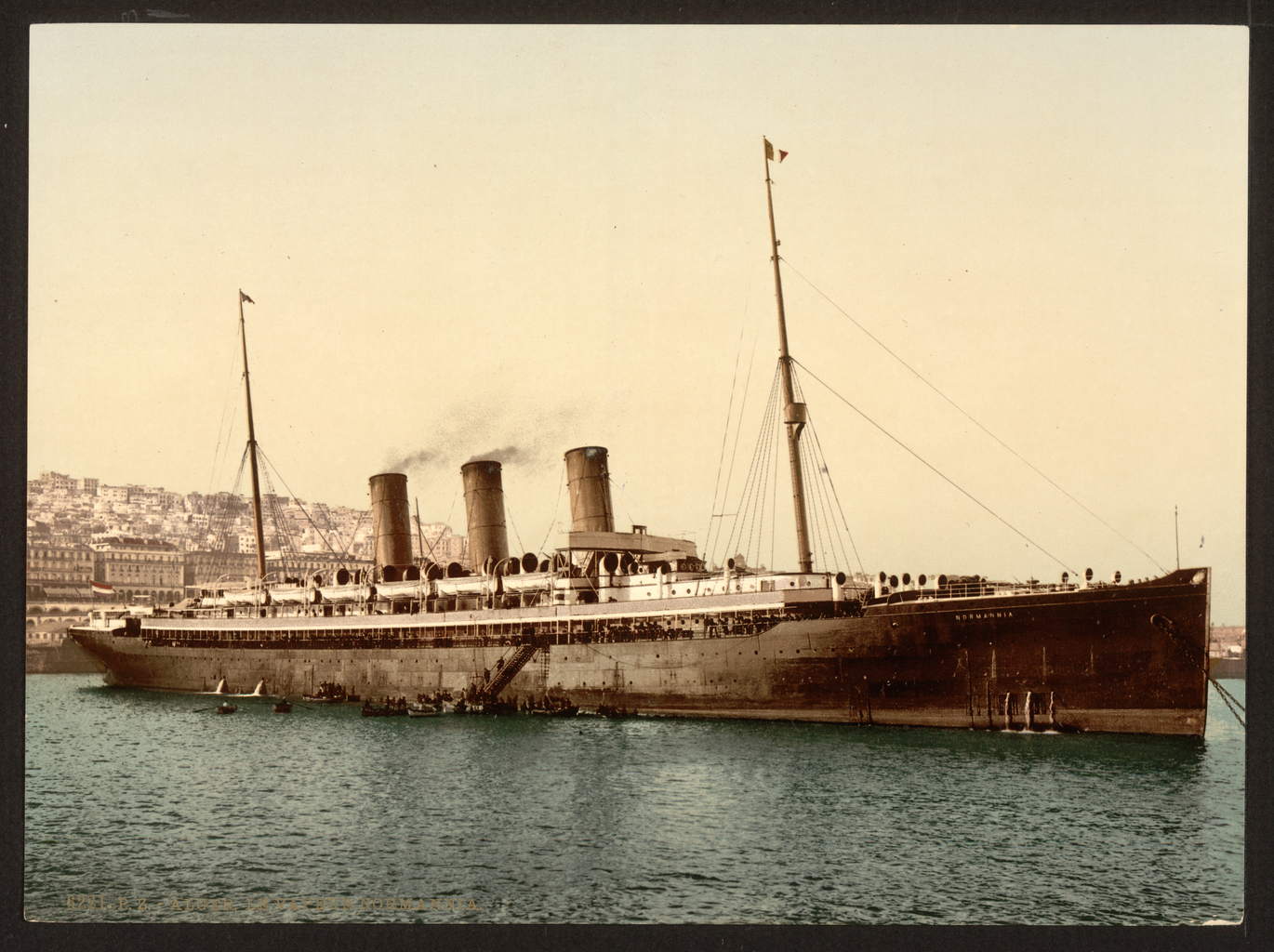
NORMANNIA, docked in Algiers, c. 1899 - source: Wikipedia
L´AQUITAINE was the first three staker for TRANSAT, which became later somehow a signature in apperance. As she was foreign built she lost her subsidies in 1905 and was sold to the breakers.In 1899 and 1900 the sister vessels LA LORRAINE and LA SAVOIE, each 11,168 GT, and built at CHANTIER & ATELIERS DE ST.NAZAIRE S.A. were commisioned. These two vessels again, the biggest French flagged civil vessel and the fastest, again sailed at the peak of the luxury offers on the North Atlantic. Her rivals have been the German Greyhounds of the LLOYD and HAPAG. Smaller than her rivals she have been nearly as fast.

LA LORRAINE coloured by © Daryl LeBlanc
Despite the success and despite anual
subsidies of 11 mio Francs Francaise, the COMPAGNIE GÉNÉRALE TRANSATLANTIQUE
ranged in 1902 on third palce after Germany and Britain. With 24,579 passengers
TRANSAT was the fifth on the Transatlantic trade, aft of HAPAG, LLOYD, WHITE
STAR and CUNARD.
When the emigrant trade peaked in 1907/08 Cie. Gle. TRANSATLANTIQUE had only a share of 10%.
Strained by its still existing
limitations in Le Havre and not fast enough growing slipways at the
shipbuilders, COMPAGNIE GÉNÉRALE TRANSATLANTIQUE sailed in absolute style in an
uncertain future.


COMPAGNIE GÉNÉRALE TRANSATLANTIQUE S.A. Shareholders silvered bronze medal - source: Wikipedia
Comments
Post a Comment