
Die Versenkung
der rms LUSITANIA, Faszination und Katastrophe
by Earl of Cruise


by Earl of Cruise
Innerhalb des vergangenen
April und in diesem Mai 2016 hatten wir zwei Jahrestage von geschichtlichen
Ereignissen in der Seefahrt, welches jedes für sich einen weitreichenden
Einfluss auf den Verlauf unserer Geschichte hatte.
Eines geschah
mitten im Frieden, und wird unter Historikern, weithin als der Beginn des
Niederganges des Britischen Empires angesehen. Das andere, während des Urknalls
des Ersten Weltkrieges, wird als das endgültige Ende einer alten Weltordnung.
Beide Schiffe
waren der Stolz der britischen Handelsmarine, wie auch generell der britischen
Nation.
Das zweite
Ereignis war der Untergang der LUSITANIA. Sie wurde durch ein deutsches
Unterseeboot, U20, durch den Abschuss eines Torpedos versenkt.

eigene Sammlung (Postkarte)
- Versenkung der rms LUSITANIA
Es herrschte 1915
Krieg, der Erste
Weltkrieg, die Urkatastrophe des 20ten Jhdt., in
welche alle Staaten der Welt sehenden Auges, und doch blind und zugleich euphorisch,
hinein gesteuert sind.
Die LUSITANIA
segelte direkt in das vom Deutschen Kaiserreich zur Seekriegszone deklarierte
Seegebiet, am 7. Mai 1915. Die LUSITANIA machte ihre 202te Überfahrt und
näherte sich an der Südküste von Irland der Irischen See und ihrem Zielhafen
Liverpool. Sie war das prominenteste Opfer des ersten "totalenKrieges"

Seekriegsgebiet um die Britischen Inseln, Quelle Wikipedia
Der First Sea Lord and Chief of Naval Staff - 1911 bis 1915 (Seelord der britischen Admiralität), ein gewisser Winston Churchill, forderte britische
und ausländische Reedereien dazu auf, dass sie ihren Schiffsverkehr nach
Großbritannien aufrecht erhielten. Die britischen Inseln waren von der Warenzufuhr
genauso abhängig, wie das Deutsche Kaiserreich, welches die britischen
Seestreitkräfte erfolgreich blockierten. Im Kaiserreich zeigten sich sehr
schnell die Auswirkungen der Blockade - Schlangen vor Geschäften und Hunger.
Die Oberste Heereskriegsleitung und die deutsche Admiralität sahen sich gezwungen
zu reagieren. Es geschah in der gleichen, für uns Heutige, stupiden Konsequenz,
wie der Gang in den Ersten Weltkrieg. Sehenden Auges rannten damals alle Mächte
Europas und die USA in eine alles verändernde Katastrophe.
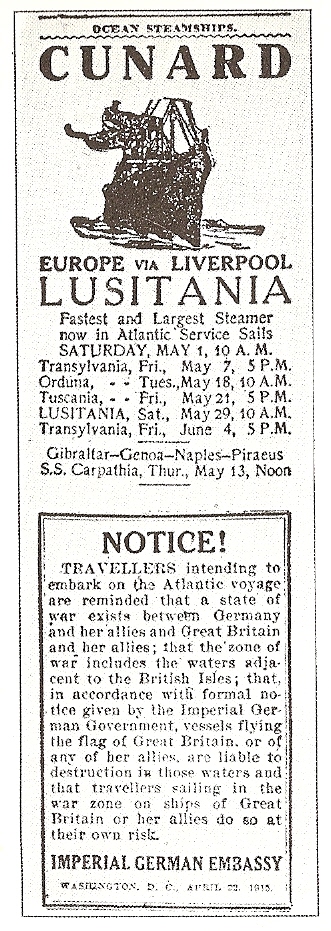
Annonce der Kaiserlichen Deutschen Gesandtschaft in Washington
Die LUSITANIA,
leichtsinnig vor die deutschen Torpedorohre geschickt, ging innerhalb von 18
Minuten mit 1.198 Passagieren, darunter 128 US Bürger, unter. Dieser Untergang
führte zu einem PR Desaster für das Deutsche Kaiserreich, obgleich die
Botschaft Deutschlands neben den Anzeigen für Überfahrten nach Großbritannien,
immer eine Warnung (Anzeige) über das Kriegsgebiet rund um die britischen
Inseln platzierte. In der Anzeige wies man jeden möglichen Passagier darauf hin,
dass er sein Leben in Gefahr bringt, wenn er mit einem Schiff unter der Flagge
eines Kriegsgegners des Deutschen Kaiserreiches, dem Kaiserreich Österreich
Ungarn und des Osmanischen Reiches in diese Seekriegszone fährt.
Kein Mensch
wollte oder konnte sich damals vorstellen, dass die LUSITANIA sich in
irgendeiner Form auf ihrer Überfahrt in Gefahr befinden konnte. Sie war
schneller als ein U-Boot. Konnte also jedem U-Boot entkommen.
Und hatte nicht
die OLYMPIC der White Star Line ein feindliches U-Boot nicht sogar versenkt?
Also warum sollte
ausgerechnet dem Inhaber des Blauen Bandes, neben der MAURETANIA etwas
passieren?
Es waren darum auch nur sehr wenige Passagiere, welche ihre Überfahrt nach Großbritannien stornierten. Sie bestiegen, nicht ahnend, dass das Schicksal sie treffen würde, die LUSITANIA.
Es waren darum auch nur sehr wenige Passagiere, welche ihre Überfahrt nach Großbritannien stornierten. Sie bestiegen, nicht ahnend, dass das Schicksal sie treffen würde, die LUSITANIA.
Die Passagiere
wussten auch nicht, dass nicht alle Kessel des Windhundes, auf dem sie sich
Sicher glaubten, aus Kohlenmangel, in Betrieb waren. Die LUSITANIA konnte
demnach nicht ihre volle Geschwindigkeit, ihre vermeintliche Sicherheit,
ausfahren. Offiziere und Mannschaften vertrauten darauf, der Feind werde es
nicht wagen sie anzugreifen, zumal allgemein bekannt war, dass auch US
Amerikaner an Bord sein würden.

Kopie aus dem Buch `Das Geheimniss der LUSITANIA´, Robert D. Ballard und Spencer Dunmore - Ullstein
Kapitänleutnant Schweiger,
Kommandant der U20, fiel nach der Versenkung der LUSITANIA in Berlin in
Ungnade. Aber nicht er wurde in Großbritannien oder in den USA zum Buhmann,
obgleich auf ihn ein Kopfgeld als Kriegsverbrecher ausgesetzt wurde, sondern die "Hunnen", das Deutsche Kaiserreich, und deutsch stämmige
Bürger des Königsreiches.

Kopie der The New York Times - eigene Sammlung

Kopie der The Daily Mirror - eigene Sammlung
War man in den
USA eher gleichgültig gegenüber dem Kaiserreich, drehte sich die Stimmung
dramatisch nach der Versenkung der LUSITANIA. Der Druck der öffentlichen
Meinung führte sogar dazu, dass deutsche Immigranten in den USA, längst deren
Bürger, sogar in ihren Wohnungen und Häusern nicht mehr Deutsch sprachen,
geschweige denn in der Öffentlichkeit. In Großbritannien kam es zu Übergriffen
auf deutschstämmige Mitbürger und Plünderungen. Besonders nachdem in
Großbritannien eine privat, in kleiner Menge, in Deutschland geprägte Medaille,
nachgeprägt und als Propaganda unter das britische Volk gemischt wurde, kochte
Volkes Seele hoch.
An Bord der Lusitania befanden sich zahlreiche bekannte Persönlichkeiten des öffentlichen Lebens, die damals großen Status genossen und international bekannt waren. Zu den Vertretern britischen Adels, der amerikanischen Hochfinanz, des Showbusiness und der Geschäftswelt, die durch die Katastrophe ums Leben kamen, zählten u. a.:
An Bord der Lusitania befanden sich zahlreiche bekannte Persönlichkeiten des öffentlichen Lebens, die damals großen Status genossen und international bekannt waren. Zu den Vertretern britischen Adels, der amerikanischen Hochfinanz, des Showbusiness und der Geschäftswelt, die durch die Katastrophe ums Leben kamen, zählten u. a.:
- Lindon Bates (1883–1915), amerikanischer Ingenieur, Ökonom und Autor
- Albert Bilicke (1861–1915), amerikanischer Bauunternehmer und Investor
- Alexander Campbell (1871–1915), schottischer Destillateur und Manager von Dewar’s
- William B. Cloete (1851–1915), britischer Geschäftsmann und Ökonom, Gründer der The New Sabinas Company
- Paul Crompton (1878–1915), Präsident der Booth Steamship Company
- Robert E. Dearbergh (1867–1915), englischer Wissenschaftler und Vize-Präsident der Earp-Thomas Farmogerm Company
- Marie Depage (1872–1915), belgische Diplomatin und Gründerin der L'École Belge d’Infirmières Diplômées
- Justus Forman (1875–1915), amerikanischer Schriftsteller und Bühnenautor (The Hyphen)
- Charles Frohman (1860–1915), amerikanischer Theaterproduzent (Peter Pan)
- Edgar E. Gorer (1872–1915), britischer Geschäftsmann und Kunsthändler, Gründer des Londoner Unternehmens Gorer
- Amelia Herbert (1856–1915), amerikanische Theaterschauspielerin (Jane Eyre, Three Wives)
- Albert L. Hopkins (1871–1915), amerikanischer Schiffbauer, Präsident der Newport News Shipbuilding and Drydock Company
- Alice Moore Hubbard (1861–1915), amerikanische Frauenrechtsaktivistin und Autorin, Ehefrau von Elbert Hubbard
- Elbert Hubbard (1856–1915), amerikanischer Schriftsteller und Satiriker, Begründer von Roycroft
- Carrie Kennedy (1862–1915), amerikanische Modedesignerin
- Charles Klein (1867–1915), englischer Schauspieler und Bühnenautor (The Lion And The Mouse)
- Sir Hugh Lane (1875–1915), irischer Kunstmäzen, Gründer der Dublin City Gallery
- Basil Maturin (1847–1915), britischer katholischer Geistlicher, Autor und ehemaliger Rektor der St. Clement’s Church in Philadelphia
- Frederico G. Padilla (1880–1915), mexikanischer Politiker, Generalkonsul für Mexiko im Vereinigten Königreich
- Frederick Pearson (1861–1915), amerikanischer Bauunternehmer und Manager, Erbauer des Damms von Medina
- Charles Plamondon (1858–1915), amerikanischer Großindustrieller
- Mary Crowther Ryerson (1860–1915), Ehefrau von Generalmajor George Ryerson, Gründer des Kanadischen Roten Kreuzes
- Anne Shymer (1879–1915), amerikanische Chemikerin und Präsidentin der United States Chemical Company
- Joseph Foster Stackhouse (1873–1915), britischer Polarforscher und Entdeckungsreisender
- Herbert Stone (1872–1915), amerikanischer Redakteur und Verleger, Vorsitzender des Verlags H. S. Stone & Company, Begründer der Zeitschriften The Chap Book und The House Beautiful
- Frances Stephens (1851–1915), Witwe des kanadischen Ministers George Stephens
- Alfred Gwynne Vanderbilt (1877–1915), amerikanischer Millionär und Pferdezüchter
- Lothrop Withington (1856–1915), britischer Historiker, Genealoge und Schriftsteller
- Catherine Dougall (1891–1915), Nichte des Schriftstellers Eugène Marais
In den Tagen und Wochen nach dem Untergang wurden etwa 280 Leichen
geborgen. Die meisten Toten wurden in drei großen Massengräbern auf dem
Clonmel Cemetery in Cobh
(damals Queenstown) beigesetzt. Eine Identifizierung war bei vielen der
geborgenen Toten nicht mehr möglich. Um viele vermisste Passagiere
entstand große Unruhe. Die Familie des New Yorker Millionärs Alfred
Vanderbilt bot eine Million Pfund für das Auffinden seiner Leiche. Sie
wurde trotzdem nie gefunden.
Der Amerikanerin Leslie Lindsey Mason, Tochter des Millionärs William Lindsey, ist in der Emmanuel Episcopal Church in Boston eine Kapelle gewidmet.
Unter den Geretteten befanden sich viele zeitgenössische Prominente wie die französische Schauspielerin Rita Jolivet, der walisische Politiker David Alfred Thomas, die amerikanische Architektin Theodate Pope Riddle, der amerikanische Automobilfabrikant Charles Jeffery, der amerikanische Geschäftsmann George Kessler, der britische Bühnenbildner Oliver Bernard und die 15-jährige Virginia Loney, Alleinerbin des Loney-Vermögens. Die letzte Überlebende der Lusitania-Versenkung, Audrey Lawson-Johnston, die in Melchbourne, Bedfordshire, England, gelebt hatte, starb im Januar 2011. Zuvor verstarb die US-Amerikanerin Barbara McDermott (* 1912, damals Barbara Anderson) am 12. April 2008 in Wallingford, Connecticut.
Quelle: Wikipedia


Beide Plakate eigene Sammlung
Der Erste
Seelord, Winston Churchill, ersehnte sich nach der Versenkung der LUSITANIA den
unmittelbaren Kriegseintritt der USA. Der Präsident, Thomas Woodrow Wilson,
reagierte aber besonnener als in Großbritannien erhofft. Er beschwichtigte
sogar. Für Winston Churchill tropfte die Zeit, bis zum endgültigen
Kriegseintritt der USA 1917, quälend dahin.
Die frischen
Truppen und die geballte Wirtschaftskraft der USA brachten die Achsenmächte,
trotz Sieg im Osten, zum Zusammenbruch. Am
11. November 1918 wurde im Wald von Compiègne in einem Eisenbahnwagen
der erste Waffenstillstand von Compiègne
geschlossen, der den Ersten Weltkrieg beendete. Beteiligte: der
französische Marschall
Ferdinand
Foch und der deutsche Politiker Matthias Erzberger.

cortsey of Shane Pendergast, FB
Wurde der Untergang der TITANIC als ein
gescheiterter Aufstand gegen die Götter des Fortschritts wahrgenommen, so nahm
man die Versenkung der LUSITANIA als einen verbrecherischen, barbarischen Akt
wahr. Es war aber ein kriegerischer Akt, trotzdem unverzeihlich, der im Verlauf eines entmenschlichten Krieges stattfand. Ähnlich der Versenkung der WILHELM GUSTLOFF am Ende des Zweiten Weltkrieges.
Mein Interesse an der LUSITANIA war ein politisch-geschichtlich motiviertes, welches die Hintergründe beleuchten wollte und Erklärungen suchte, und nicht revisionistisch. Was mich an der Causa LUSITANIA so entsetzt, ist die Tatsache, dass immer noch Volkes Seele daran hochkoch und den "Hunnen" "eins drüber" geben will ... Erinnerung ist in diesem Fall immer tragisch, aber wir leben Heute und nicht in der Vergangenheit ... Auch wenn man Angesichts der auftauchenden Fratzen der Demagogen anders denken könnte.
Comments
Post a Comment